

Senior mathematics rarely falls apart on the new content. It falls apart on fractions, negatives and algebra that were never mastered. These are skills a hard question assumes are already automatic. When they're not, half the working gets spent just getting to the real problem. Stage 4 is when that's still easy to fix.
The tutors at Exceed genuinely check up on individual students and try to keep up with what they're learning at school while providing the fundamentals you can get only through extra help with tutoring. They are always happy to help any time a student is struggling, which creates such a positive environment where you constantly want to come in and learn. I'm now confident when there are upcoming exams because Exceed has set me up with a wide range of questions that have solidified my confidence.
 A.K.Carlingford High School · Mathematics
Scope and sequence
Every week of the year, planned in advance.
Pick a year, a term and a week to see what each lesson covers.
Year 7
48 lesson weeks across four terms and the holiday programs. Choose a term.
What we work on at this stage.
- 01
Automatic mechanics
Integers, fractions, negatives, index laws. These must be made automatic, otherwise a student spends half their attention on the arithmetic before they even reach the question.
- 02
Algebraic fluency
Students learn to read an expression rather than pattern-match it, paying attention to what the letters stand for, and what the equation says.
- 03
Decode questions accurately
Students must say out loud what the question is testing. At this stage, misreading the question costs more marks than errors in method.
- 04
Legible solutions
Setting out a solution legibly is a habit far easier to build in Stage 4 than to fix in Year 11.
What a week looks like
One lesson, one set, marked and back.
The same rhythm every week of term, so students keep practising these habits.
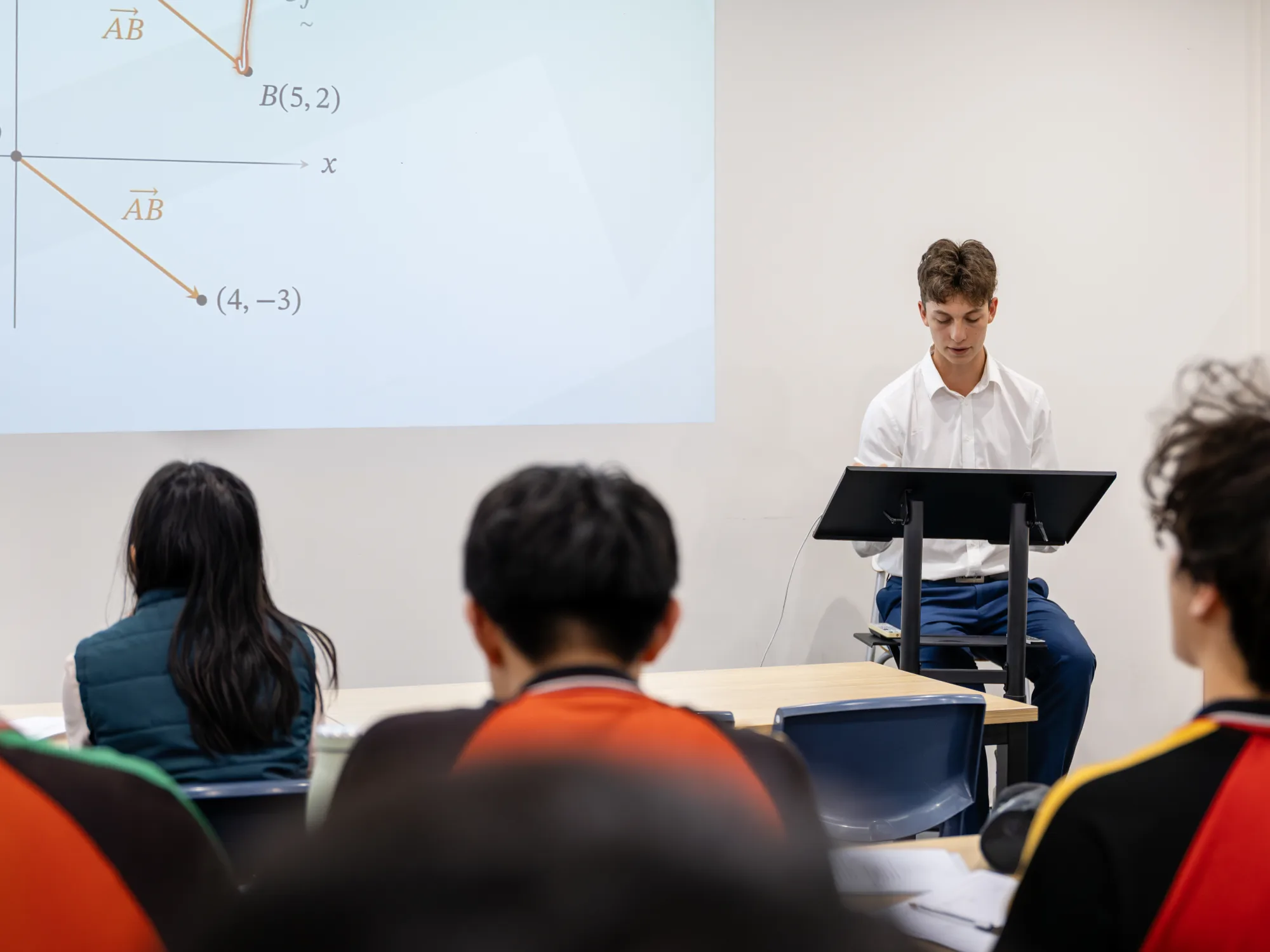
The lesson
2 hours · Small Group · EppingNew content is taught in full, with every step of the working shown, and then the class works. Mechanics (fractions, negatives, index laws) get their own drill time, separate from the topic of the week, until they are automatic.
The set
Homework every weekA set follows every lesson. Alongside the week's topic it carries questions the class has not seen worked, because reading a question you haven't seen before is a skill students need to build in Years 7 and 8.
The marking
Marked by our marking teamWork is marked by a dedicated team, not squeezed into the last ten minutes of a lesson, and comes back with the exact step that went wrong marked, not just a total.
The next lesson
One tutor who knows the workThe tutor opens on what the marking showed. The same tutor sees the same student's work every week, so a gap is caught the week it appears, and a student who is ready moves up.
Neo · included with every Mathematics lesson
is our online learning platform, built on each student’s marked work.
It is a website each student logs into from home. It keeps all of their marked work in one place, shows which topics need more practice, and lets them ask for help with a question they are stuck on.
- Built in-house. Neo is Exceed’s own software, built and run by our own team.
- Built on real marked work. Every number on it comes from work our markers have marked. Students don’t rate themselves, and there’s no placement test.
- It prepares for their assessments. Upload the school’s assessment notice and Neo focuses practice on what the task will cover.
- Included with every Mathematics lesson. Every enrolled Mathematics student has an account. There is nothing extra to pay.
Your learning overview
Welcome back, Leo
Here’s a clear view of your progress in Year 8 Mathematics.
Year 8 · Class 8 MTH
Most recent marked work
14 JulyAlgebraic techniques — HW 6
29/38
76% of available marks↑ 5 pts vs last task
A note on your progress
Based on recent workYou're improving steadily. Index laws and integer work are your strongest. The quickest marks to gain are in expanding and factorising and percentage increase and decrease: set out every line of the working on those questions.
Your tutor’s guidance, grounded in your marked questions.
Overall readiness 63% · up 4 pts since 1 Jun
Today's lesson
- —Your revision sheet10 questions · ready — you will reattempt it today
- —Homework8 questions · not marked yet
- 71%Classwork6 questions · 10 of 14 steps sound
A good place to focus
Prioritised from your recent attempts and exam scope
- Expanding and factorising36% readyAlgebra· 6 recent questions
- Percentage increase and decrease40% readyNumber· 5 recent questions
- Area of composite shapes47% readyMeasurement· 4 recent questions
Your skills at a glance
Readiness based on marked questions
- Geometry72%
- Statistics70%
- Number63%
- Measurement60%
- Algebra59%
15 question types assessed across 5 topics · unattempted types are left unscored
Recent work
Your marked papers and what they show
- 76%Algebraic techniques — HW 629 of 38 steps sound · 14 Jul
- 71%Angle relationships — in class25 of 35 steps sound · 10 Jul
- 62%Half-yearly practice paper30 of 48 steps sound · 3 Jul
- 64%Percentages — HW 516 of 25 steps sound · 1 Jul
- 66%Index laws — in class20 of 30 steps sound · 24 Jun
Marks per task
This termMethod. Every figure is computed from the questions you answered in class — mastery estimates your chance on a typical exam question per topic; the projection extends your recent trend. New topics stay unscored until enough attempts. Refreshes after each marked session. What Neo can see when you chat →
Show the full dashboard

The home screen

Demonstration data: Leo is not a real student.
Classes and rates
Term 4, 2026: 12 October – 12 December, at Epping.
Sydney time. Holiday lessons are optional and run outside this timetable.
Classes
Monday
- 4:30 – 6:30 pmYear 8
Tuesday
- 4:30 – 6:30 pmYear 8
Wednesday
- 4:30 – 6:30 pmYear 8
- 5:30 – 7:30 pmYear 7
Friday
- 4:30 – 6:30 pmYear 7
- 4:30 – 6:30 pmYear 8
- 4:45 – 6:45 pmYear 7Accelerated · Year 6 students
Year 7
- Wednesday5:30 – 7:30 pm2 hours
- Friday4:30 – 6:30 pm2 hours
- Friday4:45 – 6:45 pm2 hoursAccelerated · Year 6 students
Year 8
- Monday4:30 – 6:30 pm2 hours
- Tuesday4:30 – 6:30 pm2 hours
- Wednesday4:30 – 6:30 pm2 hours
- Friday4:30 – 6:30 pm2 hours
Group lessons are two hours. Fast Track lessons are not on the grid: they are 90 minutes, timetabled around the student and agreed at the consultation. A school-specific class opens when four students from the same school enrol. A Year 6 student who is ready for Year 7 work can join the accelerated class. Ask at the consultation.
Rates
Two formats, one rate each. Group lessons follow the week-by-week sequence above. Fast Track, available by our recommendation, is the option when a student cannot keep pace with the room, or should not have to: tighter pacing, aimed at a specific gap rather than the next chapter.
The first step is a Diagnostic Consultation, $100 per subject, and it comes off the first invoice. The full rate card
Sit a diagnostic test, and we’ll work through it with you.
- You enquire.
Enquire through the website, and we will get back to you to book in a consultation.
- The consultation.
Attend your one-on-one consultation (priced at $100 per subject), in Epping. If you go ahead with lessons, the $100 is taken off your first invoice. Bring the test and the questions you got stuck on.
- An honest answer.
You’ll start with knowledge of where the gaps are, what we’d do about them, and whether Exceed is the right fit.