

We teach three senior mathematics courses: Advanced, Extension 1 and Extension 2. Both Extension courses take the Advanced work for granted, so that is where we start. Extension 1 and 2 follow once that base is secure. A student who no longer has to think about the Advanced steps can put all their effort into the reasoning, which is what Extension questions mark.
For both English and Maths, I was ranked in the 80s before joining Exceed, constantly averaging around 70%. After joining Exceed, I got full marks for all remaining English tasks and ended the year ranked 12th. I have continued to be a top-ranker throughout Year 11. For Maths, I've been averaging 99% and ranked 4th in the grade.
 I.L.Normanhurst Boys High School · English · Mathematics
Scope and sequence
Every week of every course, planned in advance.
Which course a student sits is decided at school. What we decide is the order things are taught in, so the course they sit is built on the one underneath it.
- Advanced2 units · HSC
Functions, trigonometry, calculus, exponentials and logarithms, financial mathematics, statistics. The calculus course, and the base both Extension courses are built on.
- Extension 11 unit · with Advanced
Further functions, further calculus, combinatorics, induction, vectors, the binomial distribution. Assumes Advanced is automatic and marks the reasoning.
- Extension 21 unit · Year 12, with Extension 1 · starts in Year 11
Complex numbers, further proof, further integration, mechanics, vectors in three dimensions. The smallest cohort in the state and the least room to hide. We start it a term before school does: it is the most demanding course in the HSC, and the extra term gives students time to absorb it.
Years 11 and 12 run in three twelve-week trimesters a year, and Year 12 ends with a Trial and an HSC intensive. Choose a course, then a trimester, then a week, and you reach the lesson itself.
Year 11
36 lesson weeks: three twelve-week trimesters. Choose a trimester.
What we work on, course by course.
We teach each topic once, and only after the topics it depends on.
Mathematics Advanced · Years 11–12
The calculus course, and the base under everything else.
Calculus starts in Advanced. Students who are comfortable with functions from Years 9 and 10 find it builds naturally; students who aren't find out quickly. Every later topic (exponentials, logarithms, series, the statistics) comes back to a function and its graph.
It is also the course both Extension papers assume. A student sitting Extension 1 is marked on reasoning because the Advanced content is taken as read, so the Advanced base is where our senior sequence begins, for every senior student.
What we work on in Advanced
- 01
Calculus that makes sense
Differentiation and integration are taught as ideas first: what a derivative measures, what an integral adds up. A student who only knows the rules has nothing to fall back on when a question changes the setting.
- 02
Getting comfortable with functions
Every Advanced topic comes back to a function and its graph. Transforming, combining and reading graphs is made automatic early, because every later topic uses them.
- 03
Working that earns the marks
In the HSC, how a solution is set out earns marks on its own, separate from whether the final answer is right. We teach the layout and justification that markers reward, line by line, from Year 11.
- 04
Unseen questions every week
Every week's set carries questions the class has not seen worked. The paper never labels a question with its topic, so neither do we.
What a week looks like
One lesson, one set, marked to the line.
The same rhythm every week, in whichever course a student sits. From Term 2 of Year 12 the sets become papers under time.
The lesson
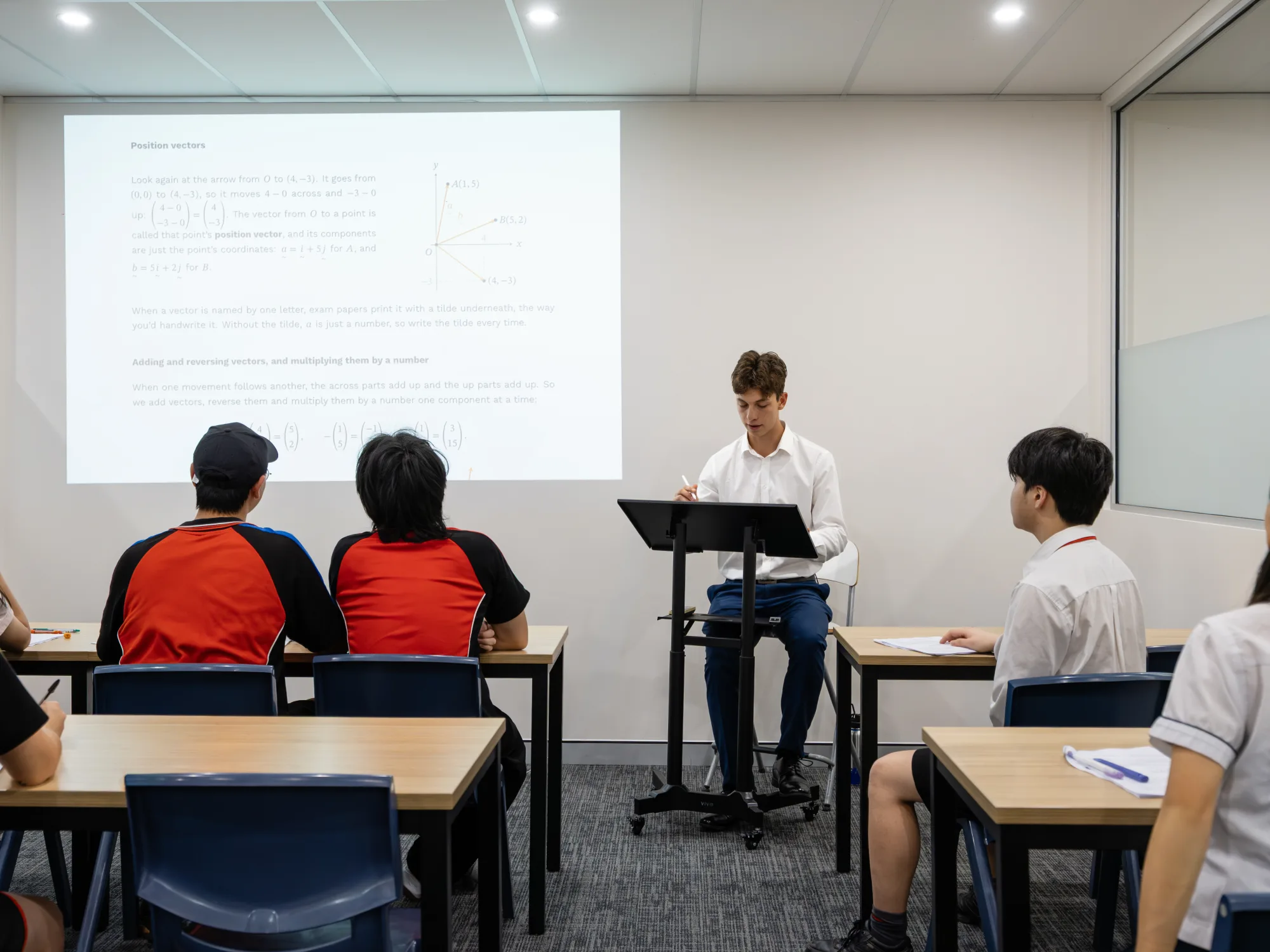
3 hours · Small Group · EppingNew content is taught in full, with every step of the working shown, and then students practise. For every session that introduces new content, several are practice, revision or a paper under time: the syllabus is small enough to teach quickly and hard enough to need a year of doing.
The set
Homework every weekPractice is interleaved: each topic's questions carry earlier topics inside them, and no question is labelled with its topic.
The marking
Marked by our marking teamWork comes back marked to the line where the method turned, with what the marker would have wanted instead. Set-out is marked the way the HSC marks it, because in the HSC the working earns marks on its own.
The next lesson
One tutor who knows the workThe tutor opens on what the marking showed. The same tutor sees the same student's work every week, so the choice of method is coached using the student's own working.
Neo · included with every Mathematics lesson
is our online learning platform, built on each student’s marked work.
It is a website each student logs into from home. It keeps all of their marked work in one place, shows which topics need more practice, and lets them ask for help with a question they are stuck on.
- Built in-house. Neo is Exceed’s own software, built and run by our own team.
- Built on real marked work. Every number on it comes from work our markers have marked. Students don’t rate themselves, and there’s no placement test.
- It prepares for their assessments. Upload the school’s assessment notice and Neo focuses practice on what the task will cover.
- Included with every Mathematics lesson. Every enrolled Mathematics student has an account. There is nothing extra to pay.
Your learning overview
Welcome back, Ava
Here’s a clear view of your progress in Mathematics Extension 2.
Year 11 · Class 11 MTH X2
Most recent marked work
14 JulyIntegration techniques — HW 9
38/46
82% of available marks↑ 5 pts vs last task
A note on your progress
Based on recent workYou're improving in every topic. Algebra and differentiation are your strongest. The quickest marks to gain are in integration by substitution and the normal distribution: attempt every part of those questions.
Your tutor’s guidance, grounded in your marked questions.
Overall readiness 64% · up 3 pts since 1 Jun
Today's lesson
- —Your revision sheet12 questions · ready — you will reattempt it today
- —Homework8 questions · not marked yet
- 73%Classwork6 questions · 11 of 15 steps sound
A good place to focus
Prioritised from your recent attempts and exam scope
- Normal distribution38% readyStatistics· 5 recent questions
- Integration by substitution39% readyCalculus· 6 recent questions
- R-formula45% readyTrigonometry· 3 recent questions
Your skills at a glance
Readiness based on marked questions
- Algebra70%
- Vectors62%
- Calculus60%
- Trigonometry59%
- Statistics47%
19 question types assessed across 5 topics · unattempted types are left unscored
Recent work
Your marked papers and what they show
- 82%Integration techniques — HW 938 of 46 steps sound · 14 Jul
- 77%Trig equations — in class37 of 48 steps sound · 10 Jul
- 66%Half-yearly practice paper33 of 50 steps sound · 3 Jul
- 68%Probability & distributions — HW 817 of 25 steps sound · 1 Jul
- 62%Polynomials — in class18 of 29 steps sound · 24 Jun
Marks per task
This termMethod. Every figure is computed from the questions you answered in class — mastery estimates your chance on a typical exam question per topic; the projection extends your recent trend. New topics stay unscored until enough attempts. Refreshes after each marked session. What Neo can see when you chat →
Show the full dashboard

The home screen

Demonstration data: Ava is not a real student.
Classes and rates
Lessons run all year, in three twelve-week trimesters.
This term's classes: 12 October – 12 December, at Epping. Sydney time. No lessons from late November to the second week of January, or during the trial exams. From mid-January, lessons run twice a week through the rest of the holidays.
Classes
Monday
- 4:30 – 7:30 pmYear 12Extension 1 · Accelerated
- 4:30 – 7:30 pmYear 12Extension 1
Tuesday
- 4:30 – 7:30 pmYear 12Extension 2
- 5:15 – 8:15 pmYear 12Extension 2
Wednesday
- 4:30 – 7:30 pmYear 12Extension 1
Friday
- 5:00 – 8:00 pmYear 12Advanced
Year 11
Year 11 joins the Year 12 classes from Term 4. See Year 12
Year 12
- Monday4:30 – 7:30 pm3 hoursExtension 1 · Accelerated
- Monday4:30 – 7:30 pm3 hoursExtension 1
- Tuesday4:30 – 7:30 pm3 hoursExtension 2
- Tuesday5:15 – 8:15 pm3 hoursExtension 2
- Wednesday4:30 – 7:30 pm3 hoursExtension 1
- Friday5:00 – 8:00 pm3 hoursAdvanced
Group lessons are three hours. Fast Track lessons are not on the grid: they are 90 minutes, timetabled around the student and agreed at the consultation. A school-specific class opens when four students from the same school enrol.
Rates
Two formats, one rate each. Group lessons follow the week-by-week sequence above. Fast Track, available by our recommendation, is the option when a student cannot keep pace with the room, or should not have to: tighter pacing, aimed at a specific gap rather than the next chapter.
One rate per year, whichever course a student sits. Extension 2 starts with us in Year 11, a term ahead of school, at the Year 11 rate.
The first step is a Diagnostic Consultation, $100 per subject, and it comes off the first invoice. The full rate card
Sit a diagnostic test, and we’ll work through it with you.
- You enquire.
Enquire through the website, and we will get back to you to book in a consultation.
- The consultation.
Attend your one-on-one consultation (priced at $100 per subject), in Epping. If you go ahead with lessons, the $100 is taken off your first invoice. Bring the test and the questions you got stuck on.
- An honest answer.
You’ll start with knowledge of where the gaps are, what we’d do about them, and whether Exceed is the right fit.