


Practice examination
Question 4 (10 marks)
Question 5 (15 marks)
Stage 4 decides how a student feels about English for the rest of high school. This is when reading age and literacy can leap forward fastest, and when confidence erodes as extended writing, analysis, and independent reading arrive faster than most students are ready for. Exceed's Stage 4 course is built for this window, delivering strong sentence-level writing, close reading habits, and regular feedback, so students walk into Year 9 reading widely, writing clearly, and feeling confident in a subject they actually appreciate.
I joined Exceed at the tail end of Year 7 after a string of poor marks that really killed my confidence in my English ability. It was after the first few lessons, where I'd learned how to structure an essay effectively, that in my next assessment tasks the marks began to turn around. From there, the way that we were taught the texts with so much detail and structure at Exceed allowed me to gain a really in-depth understanding when interpreting texts, leading to an average of around 19/20 for the majority of high school.
 I.C.North Sydney Boys High School · English
What you receive
A place in Years 7–8 comes with four things. Every student gets all four.
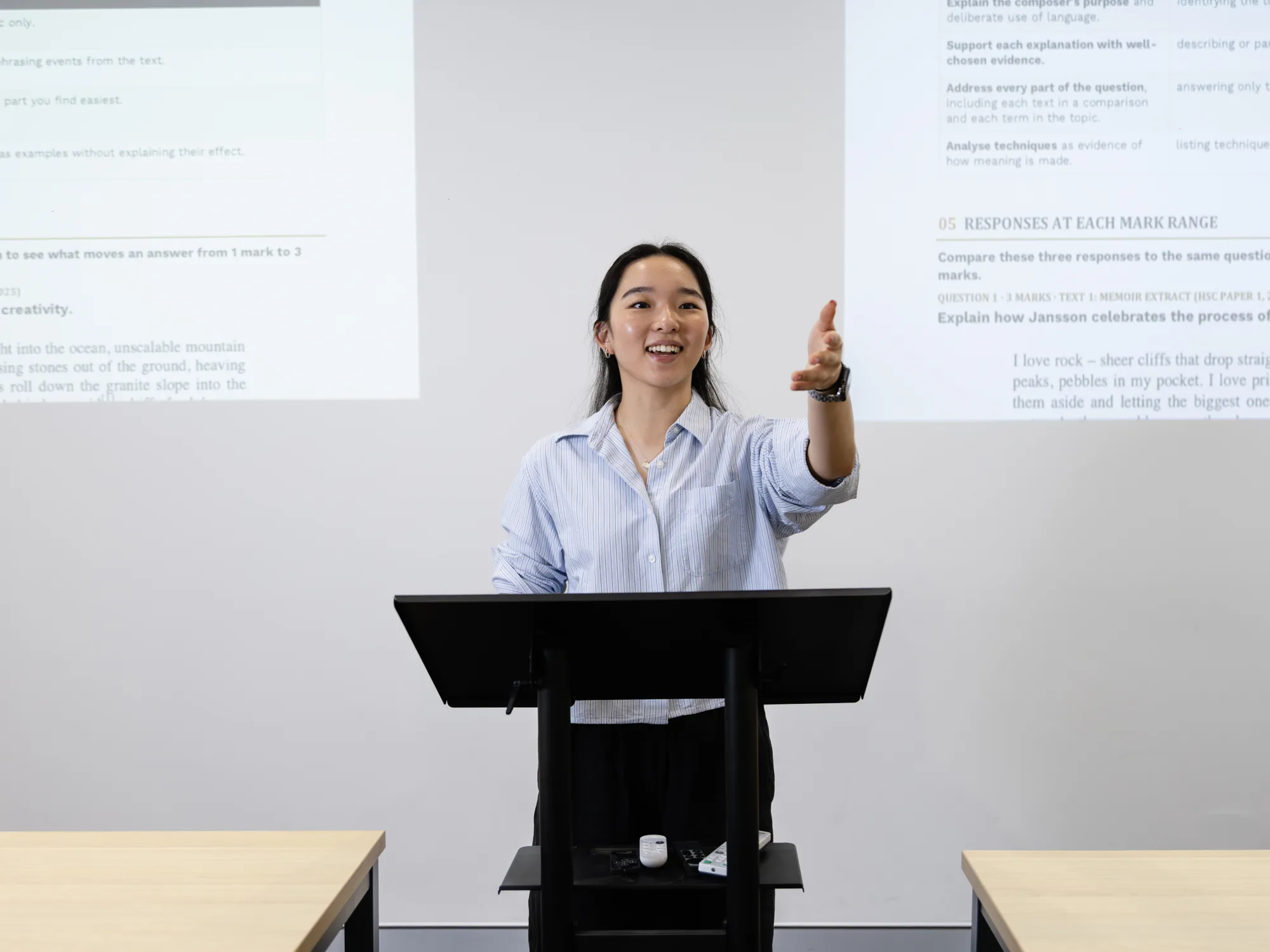
Learn alongside others. Improve with intention.
Small-group lessons with the structure, teaching and attention a Year 7 or 8 student needs to take extended reading and writing seriously, without disappearing in a crowded classroom.
Question 4 (10 marks)
Question 5 (15 marks)
Name the technique, then say what it makes the reader feel.

Material written for Stage 4, not handed down from Year 12.
Booklets built around close reading, sentence control and the paragraph with a job, across the prose, poetry, drama and visual texts the Stage 4 syllabus expects.
How does Palacio show that kindness takes courage in Wonder?
Palacio shows that kindness is a choice with a cost, and she makes the reader watch Jack pay it.
When Jack sides with Auggie, Palacio switches to short, blunt sentences, so the moment slows down and we feel how hard it is.
The other students stop talking to Jack, and the chapter ends without anyone thanking him.
Kindness here is not easy or rewarded. It is brave because it costs Jack his friends.
See what a strong paragraph looks like.
Model paragraphs and short responses annotated by tutors, so students see the point, the evidence and the reason it matters, and why the sentence holds.

Know exactly which sentence to fix.
Most Stage 4 marks are lost inside the sentence. Feedback names the slip, shows the rewrite, and gives one clear target for the week.
1 of 4: Group classes
Our emphasis for Stage 4
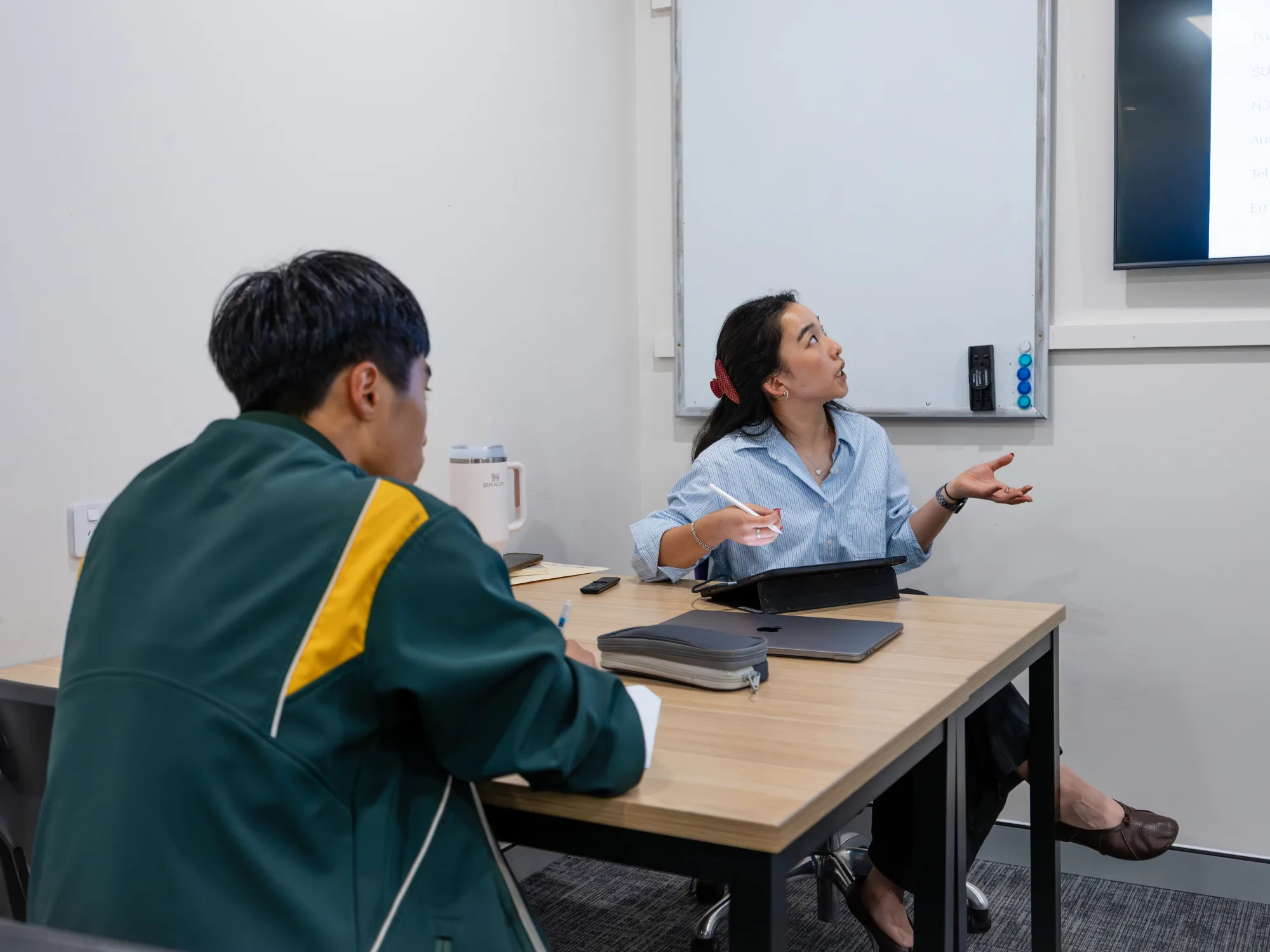
An increasing number of students are entering high school with neither a grasp of basic grammar nor the ability to construct complex sentences. Addressing these gaps early matters because sentence-level control is cumulative: without a solid grounding in grammar and syntax, students cannot naturally progress toward the sophistication of expression the senior years demand.
Many Stage 4 students skim-read texts through a literal interpretive framework, looking for plot rather than for meaning. We train students to read beyond the literal and pay attention to how a text is constructed. Close, inferential reading is what will be expected of them in the later years of high school, not summary of obvious details. We focus on helping students begin to develop interpretation grounded in a text's specific choices rather than its plot.
Essay writing is where Stage 4 students start losing marks in English — and where a kind of learnt helplessness sets in. Faced with what feels like a convoluted, unwritten list of demands, many come to see textual analysis as a talent some students simply have and others don't, rather than a skill that can be taught. We treat the essay as a simple, learnable form: breaking it down into its key components and making the criteria for success explicit, rather than assumed. We teach the IQTVE framework of analysis, a five-part structure for analytical paragraphs that moves students past retelling the plot and into analysing the text. Students build fluency with it first at the paragraph level, then carry that same structure into full senior essays.
Stage 4 students arrive fluent in spoken and casual written English, but the academic register (precise diction, an impersonal or evaluative tone, subordination and nominalisation) is a distinct, learned code that has to be taught explicitly. Without it, even a strong idea can read as unconvincing or imprecise. We build this register deliberately, modelling sentence- and paragraph-level academic expression and giving students the specific vocabulary and syntactic structures to write with authority.
What we cover
Close reading and comprehension across prose, poetry, drama and visual texts; understanding how a text positions its reader; responding with evidence rather than summary.
Narrative, persuasive and informative writing; planning and structuring a response; drafting and editing as separate skills.
Sentence structure, punctuation, paragraphing, vocabulary building, spelling patterns, and the terms of textual analysis.
Classes
Sydney time. No classes in the school holidays.

No class

No class
A class named for a school is for students from that school. If you would like a text-specific or school-specific class that isn't listed, we need at least four students to consider opening one.
Enquire through the website, and we will get back to you to book in a consultation.
Attend your one-on-one consultation (priced at $100 per subject), in Epping. If you go ahead with lessons, the $100 is taken off your first invoice. Bring the essay and its feedback sheet.
You’ll start with knowledge of where the gaps are, what we’d do about them, and whether Exceed is the right fit.